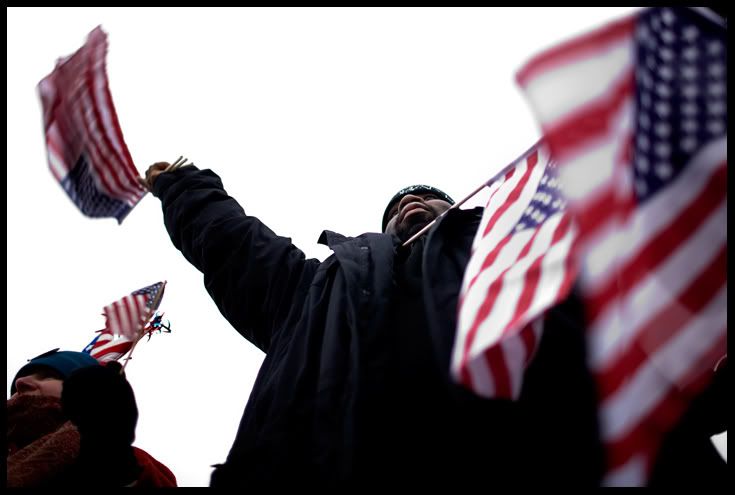
Monday, January 19, 2009

An inauguration blog


I'll be watching the inauguration at the Palace Theater in Playhouse Square, but Cleveland Magazine has a correspondent in Washington this week, sort of: Kristin Majcher, a recent intern for us, is one of three reporters blogging from the capital this week for the Athens News, a newspaper in Athens, Ohio.

Their blog is at athensinauguration.blogspot.com. Check it out.

Sunday, January 18, 2009

PD says goodbye to Bush

I roll my eyes when someone says the Plain Dealer is "too liberal," but I also roll 'em when someone says it's "too conservative." Do angry PD-hating liberals read the paper? Connie Schultz? Dick Feagler, after the Iraq invasion? Elizabeth Sullivan, before and since the invasion?

Or the editorial page, whose horror over the Bush Administration grew and grew?

Today the page does its final penance for endorsing George W. Bush in 2000. It's hardly the angriest or most damning denunciation of him. (This is what it sounds like when a newspaper does that.) It starts off as a spurned love's "thought I knew you" lament. "We liked his talk about humility and compassion," it says.

That's an allusion to Bush's "compassionate conservative" slogan and his famous line in the second Bush-Gore debate about the rest of the world -- "If we're an arrogant nation, they'll resent us. If we're a humble nation, but strong, they'll welcome us." I watched that debate too, and I remember thinking the line sounded insincere. I guess the PD believed him.

But the editorial really gets going in its second half. I'll just quote some key words it attaches to Bush: squandered, ignored, surrendered, degradation, disdain, squandering (again), refusal. Read it and you see why the PD endorsed Obama, and how the Bush era led the editorial page from center-right in 2000 to center-left today.

Friday, January 16, 2009

PD's Sweeney deathwatch -- and a failed coup


Martin Sweeney, Cleveland's city council president, has been in the news a lot lately, and almost every time, the Plain Dealer speculates he's about to be deposed. But now, Sweeney's made a power play: he's banished Matt Zone from council's powerful finance committee for vying to unseat him.

Turns out Zone (photo at right) was trying all last year to get the 11 votes needed to replace Sweeney (at left) as council president. Then he spoke out publicly against Sweeney, saying the council was redrawing its ward map too secretly. So Sweeney gave Zone the boot.

"If you decide to oppose the direction of council leadership, you will also stand to lose plum committee assignments," Sweeney explained.

PD reporters must've known about Zone's efforts -- it'd explain their extended Martin Sweeney deathwatch throughout 2008. It's not over: Zone tells the paper the fall council elections could change the factions on council and depose Sweeney.

What would a change in leadership mean for Cleveland? Zone, who represents the Detroit-Shoreway neighborhood, is smart, independent, and assertive about issues he cares about, such as supporting arts and culture.

If he took over as leader, I think council would become more assertive, more of a check and balance on Mayor Frank Jackson's power.

Sweeney succeeded Jackson as council president because he was Jackson's top lieutenant. That's why council hasn't challenged the mayor on much at all in three years. Racking my brain, I can only think of a few newsworthy occasions when council has shown leadership independent of the mayor. One was on tax abatements for new homes -- Jackson wanted to cut back on them, but council convinced him not to. A second was the new domestic partner registry, designed to make Cleveland more gay-friendly -- that was council's idea. The third, which was symbolic, came when Jackson said little about the Kinsman shooting incident in 2007, so council stepped up.

Relations between Cleveland's mayor and council swing like a pendulum. When Mike White's term as mayor ended, Clevelanders wanted an end to the strife between him and Mike Polensek's council faction. (Polensek had taken power in a 1999 coup because council felt White was walking all over them.) Mayor Jane Campbell tried to usher in an era of peace, but her falling-out with Jackson led to his successful run to replace her. Now the pendulum has swung so far toward peace and cooperation that the council rarely challenges the mayor.

Sweeney's move shows he feels his hold on power is still strong, despite questions about his leadership and his name appearing on subpoenas connected to the county corruption probe. Just as in the recent special elections in Hough and the Lee-Harvard neighborhood, lots of council races this year will shape up as pro-Sweeney vs. anti-Sweeney races (which must be why the ward redistricting is so important to Zone).

What the elections will mean for the mayor, I'll get to next week.

Friday, January 9, 2009

My favorite columnist


No disrespect to my favorite Plain Dealer writers. But my favorite local political columnist these days is Mansfield B. Frazier of CoolCleveland.com.

Frazier wrote the best stuff out there about the fight over who should succeed Fannie Lewis on Cleveland City Council. His CoolCleveland piece on how Obama-worship is getting out of hand was so funny, the Plain Dealer picked it up as an op-ed.

His column this week is a very personal, suspenseful, and terrifying story about his son and ex-wife -- and it ends with a sudden but effective turn to the gay-rights battle brewing in Cleveland.

Journalists often lament that our profession has gotten too professional, no longer a haven for interesting characters. Guess they don't know Frazier. This week's column attests to the wild life he's lived. So does his 1995 book, From Behind the Wall -- the author's bio notes he's been "arrested 15 times on felony charges and convicted 5 times."

Sometimes I wish CoolCleveland edited him more, to hone the rough diamond and ask the unanswered question (such as, Do you really think your wife did what she hinted at? If so, how?). On the other hand, his rough edges are part of the fun.

This became obvious when I compared Frazier's original Obama column and the edited version in the Plain Dealer. Most of the edits improved it (including the helpful correction that the plural of "honky" is "honkies"). But PD readers lost his aside about the late Ms. Lewis ("sharing only went so far with Fannie"), his assessment of Obama as "cooler than Frosty the Snowman," and a great digression about a Harlem street hustler nicknamed Seldom Seen, who "knew that in all cultures and societies, too much access deflates value and diminishes cachet."

There's no archive page for all Frazier's columns, like fellow CoolCleveland columnist Roldo Bartimole's blog. But you can go through the CoolCleveland archives and find a link to Frazier's column in each issue. Also, he's got a new gig with TheDailyBeast.com (so far he's written about how alleged pyramid-schemer Bernard Madoff will like prison). Plenty of Mansfield for us to dig into.

Thursday, January 8, 2009

NYT Mag memorializes Stephanie Tubbs Jones


The New York Times Magazine looked back on Stephanie Tubbs Jones' career in its year-end issue, "The Lives They Lived." Matt Bai's elegant obituary captures aspects of Cleveland's late congresswoman that we didn't often see.

After her husband died, Tubbs Jones poured herself into friendships with other congresspeople, including Florida's Kendrick Meek and New York's Yvette Clarke — and Hillary Clinton. Tubbs Jones and Clinton bonded over a concern for voting rights, forging a loyalty that led the congresswoman to campaign for Clinton in her presidential run, despite Barack Obama's popularity in her district. (I wrote about Tubbs Jones' pledge to Clinton and her 2001 support of mayoral candidate Raymond Pierce, controversial for an opposite reason, in our October issue.)

Bai's article mentions some of Tubbs Jones' flaws — her "penchant for jetting off to exotic lands on privately financed junkets," a backhanded comment she made about Obama. But mostly, he illuminates her loyalty to friends and her sense of humor. The piece also led me to this great clip from Comedy Central's "The Colbert Report," in which Stephen Colbert, playing off Tubbs Jones' judicial experience, gets her to play-act the title role on an imaginary TV show, "Judge Tubbs."


Monday, January 5, 2009

Reform is dead

Oops, sorry. Less than two months ago, I predicted the movement to reform Cuyahoga County government would dominate Cleveland's headlines in 2009.

Actually, just before Christmas, the state legislature killed the idea. It took the Commission on Cuyahoga County Government Reform's proposal for a leaner, less costly government and threw it onto the shelf, where all such plans turn brittle yellow, then molder away. Someone's already pulled the plug on the commission's website (the lonely, barely Google-able ccgovreform.org), but here's another link to its proposal.

The legislature created the reform commission in June, so I naively figured it would let county residents vote on its plan. Guess not.

The state House backed the plan, but Republicans in the state Senate voted for a different proposal to replace the Cuyahoga County commissioners with an executive and nine-member council. Rather than write a compromise, the legislators let the idea die with the lame-duck session. Rep. Armond Budish, the new Speaker now that the Democrats control the House, said that in 2009, any reform ideas will have to apply to all 88 counties. That likely means reform will never happen -- it multiplies the number of vested interests motivated to stop it.

Killing reform was easy. Its champions aren't in positions of power. Once people started disagreeing about how far to go with it -- Louis Stokes vs. the rest of the commission, House Republicans vs. Senate Republicans -- doing nothing became the easiest option. Elected officials who benefit from the status quo only had to keep quiet for the idea to go away.

County treasurer Jim Rokakis, who supports reform, estimates the county government wastes $40 million to $60 million a year. The recorder's office, ripe for a $1 million budget cut, is just one example. But if Cuyahoga County taxpayers want change, the state legislature is not going to help. Voters will have to create a charter, like Summit County did years ago. It's not easy: it takes a petition drive and more than 45,000 signatures.

Friday, January 2, 2009

Medical Mart: The mayor gets mad

I was going to blog today about Frank Jackson, The Quiet Mayor. But Jackson's on the Plain Dealer front page today, angrily asking what's going on with the Medical Mart project.

This is big news. For three years, Jackson has deferred to the Cuyahoga County commissioners on the convention center and Medical Mart. No more. After reading about the project's latest delay, he called the PD on New Year's Day to say the county didn't consult him and that he'll travel to Chicago to talk to the developer himself.

Jackson's declaration will surprise and impress the people who think he's a weak leader. It's the kind of dramatic big-stick moment that they long for from a mayor.

Surely the mayor is stepping up because he's lost confidence in the county commissioners. They've been promising for several months that they're this close to nailing down the Medical Mart deal. These days, Jimmy Dimora, waiting to see if the feds indict him, is saying little in public. He, Tim Hagan and Peter Lawson Jones have cast their fates with MMPI, so when the developer blows their "deadlines," they can't do much but ask for patience. Jackson senses he has to step in to save the project -- and keep the developer from cutting corners by building a too-small convention center.

It's been a year and a half since the commissioners voted to raise the sales tax to build the convention center and Medical Mart. The county has collected more than $50 million so far, but there's nothing to fund. The developer, MMPI, rejected the Greater Cleveland Partnership's recommendation to build it at Tower City, and it's doing its own study of the site and a downtown Mall location. As delays pile up, the county, its negotiator, and the developer are practically silent. Meanwhile, plans for a competing medical mart in New York City are moving forward.

If Jackson's trip to Chicago brings progress on the Medical Mart, reporters will call it a turning point for his first term. I'll write more about the mayor soon.