Showing posts with label Zack Reed. Show all posts

Monday, November 3, 2014

Will Cleveland voters shut down traffic cameras?

It’s the election’s sleeper issue: Cleveland’s traffic cameras. For nine years they’ve watched over major intersections and avenues, snapping photos of drivers’ license plates when they detect a speeder or a red-light-runner.

Tomorrow, Cleveland residents will decide whether to shut them off.

To supporters of Issue 35, which would effectively end the city’s traffic camera program, Election Day is the citizen’s chance to fight back against an unfair system and a government trying to raise cash. An anti-camera Facebook page has posted a picture of Mayor Frank Jackson, altered to show glowing dollar signs in his eyes. Jackson has warned that he’ll have to cut $6 million from the city budget if the cameras are shut down.

“If the mayor and council was concerned about safety rather than revenue, they probably would have looked at safety data sometime in last nine years while the cameras have been up,” argues petition drive organizer Jason Sonenshein. “They haven’t compiled that data.”

Issue 35’s backers spent four years gathering petition signatures for their proposed charter amendment. A yes vote would ban photo traffic enforcement in Cleveland unless a police officer is on the scene and personally issues the ticket. (That would reduce the cameras to expensive alternatives to radar guns.) A no vote on Issue 35 would preserve the camera program.

“I’m mostly concerned about the lack of due process with camera tickets,” says Sonenshein. “They ticket the owner, not necessarily the driver. If you weren’t driving, it’s up to you to prove your innocence, rather than up to the government to prove you’re guilty.”

Camera tickets can be appealed, and Cleveland Magazine recently found that about half of appeals result in a dismissal or reduced fine. But Sonenshein says only four percent of ticketed motorists appeal. "A lot of people can’t afford to take off work," he says. Hearing officers aren’t neutral, he complains, because they’re employed by the city, not a court.

The mayor and various city councilpeople, including council president Kevin Kelley, oppose Issue 35. Councilman Brian Cummins has posted arguments for keeping the cameras on his website. He and others argue that the cameras deter residents from speeding, that most of them are deployed in high-crash areas, and that they free police officers to combat violent crime. Bike Cleveland, the cycling advocacy group, also opposes Issue 35, arguing that the cameras help keep cyclists and pedestrians safe by slowing down car traffic.

I asked Sonenshein to answer the safety arguments, including the point on Cummins' website that pedestrians are likely to survive a collision with a car driving 20 mph, but likely to die if hit by a car going 40.

“There are lots of ways to improve the safety of the streets without raising the risk of punishing innocent people,” Sonenshein says, suggesting narrower traffic lanes and longer yellow lights. He also says the city hasn’t done a thorough study of the camera’s effects, and that a national study that claims traffic cameras reduce fatal crashes by 24 percent is flawed.

The camera debate cuts across the usual political divides. Sonenshein and several other petition organizers have a libertarian bent.  (Sonenshein's anti-camera PAC is called Liberate Ohio. He says it's spent about $1,300.) Councilmen Jeff Johnson and Zack Reed, usually allies, are on opposite sides of this issue. Johnson has defended the cameras, saying neighborhood groups often request them. Reed says he's become convinced the camera program is really about revenue, not safety. Most of council has long supported the cameras, but Joe Cimperman has voted against them, arguing they lead to rear-end collisions.

Wednesday, July 23, 2014

Civic Commons holds an East Cleveland merger forum -- and it doesn't go well

Photos by Anthony Price
There are some problems that “thought leaders,” “facilitators,” and whiteboards filled with talking points can’t fix.

That became obvious really fast last night at a Civic Commons forum in East Cleveland about the idea of the town merging with Cleveland.

About 60 people came to the event at the East Cleveland Public Library, including East Clevelanders, Clevelanders, and people from suburbs from Euclid to Pepper Pike. Despite the serious financial problems that beset the town of 17,000, no one spoke in favor of a merger, and more than a dozen East Cleveland residents spoke out against it.

Civic Commons moderator Andrew Samtoy asked people to list negatives about a merger, and residents responded with such force that Samtoy never dared to ask for positives.

East Clevelanders said they’d lose their own mayor and council, City Hall and police, autonomy, political power, home demolition program, and direct grants from the federal government. Many questioned whether Cleveland’s poor neighborhoods are any better off than East Cleveland.

“I see Cleveland has a lot of big developments,” said M. LaVora Perry of the East Cleveland Narrator, but “those don’t trickle back to the core community. Certain neighborhoods seem to be thriving,” she added, but in others, “I don’t see anything being done.”

Several East Clevelanders said, to applause, that the Nov. 2012 Cleveland police chase and fatal shooting, which ended in East Cleveland, made them not want to join Cleveland. The East Cleveland police, one man said, have a good relationship with the community and are more likely to defuse a crisis without force.

Many in the room asked why the forum was held at all. Almost all of the merger talk of the last several months is coming from Cleveland leaders and commentators. Public opinion among East Clevelanders is strongly against a merger. So the Civic Commons’ attempt to get them to talk about merging backfired, setting off fears of a condescending and hostile takeover.

“They’re trying to build a narrative to convince East Cleveland residents to support the idea,” said Michael Smedley, chief of staff for East Cleveland Mayor Gary Norton. “They want to have a series of community forums to get you beyond your fears.”

More likely, the Civic Commons simply had no idea what it was getting into.

The event was a lesson in how not to introduce oneself to a community. The Civic Commons had no East Clevelanders scheduled to speak when it announced its event. It held the forum on the same night as East Cleveland school board meeting and city council committee meetings. It promoted the event heavily on Twitter, Facebook and public radio, but those outlets don’t reach a lot of East Clevelanders, who still promote civic events with flyers and announcements at other town meetings. Despite a weeklong social-media barrage, many East Clevelanders expressed surprise that the forum was so lightly promoted. By the event’s end, Civic Commons director Mike Shafarenko was promising they’d do better next time.

Exchanges between East Clevelanders and Cleveland city councilman Zack Reed got testy. Reed introduced himself with a joke — “I’m a little late, because [when] we do take over, we’re going to get rid of those red light cameras” — that angered many in the takeover-wary crowd. Reed sharply challenged East Cleveland councilman Nathaniel Martin’s claim that East Cleveland’s mayor is more accessible than Cleveland’s.

The event became a lesson in East Cleveland’s distrust of outsiders. Some residents talked angrily about the flight of businesses and capital from their city, including the Cleveland Clinic’s 2011 closing of Huron Hospital. Some cast the merger idea as a land grab by University Circle interests.

Finally, Cleveland councilman Mike Polensek salved the tensions with a mix of diplomacy and expressions of solidarity. “We came here as guests,” he said. “We’re not trying to take over.”

Most Cleveland city councilpeople are not in favor of annexing East Cleveland, Polensek said. “We’re here as neighbors, to assist,” he said. Cleveland has already taken over East Cleveland’s water department, he said, and he raised the possibility of more shared services and mutual aid agreements.

But Polensek warned three times, in a polite and neighborly way, that East Cleveland needs to deal with its serious fiscal problems if it wants to stay independent.

“The elite cannot push any agenda if your city is solvent,” he said. “If you get your act together, and have a balanced budget, you can make the city what you want it to be.”

Hanging over the forum, but never quite spoken, was the awful math of abandonment. East Cleveland is about to borrow almost $7 million to pay off its many debts and deficits. It’ll borrow against future local government funding from the state, which likely means even more layoffs and service cuts to come. The city’s tax base has shrunk dramatically in the last few years, shrinking its budget from $17 million in 2010 to about $11.5 million this year.

The price of independence is rising. Will a time come when even proud and independent East Clevelanders are no longer willing to pay it?

As the meeting wound down and the crowd thinned, Smedley, the mayor’s chief of staff, who had earlier declared, “there is no benefit at all to a merger,” acknowledged that it could be the fallback plan if the city can’t claw its way out of fiscal crisis.

First, Smedley said, East Cleveland needs to see if neighbors such as Cleveland and Cleveland Heights can help “give us a real shot at saving this community.”

“What we’re trying to do is to position ourselves to give us the best shot at it, and if we fail, we know that we tried our best,” Smedley said.

“And then, if merger is where we need to be at that point, I guarantee you, the government… as well as the residents, who’ve been pouring their hearts and souls into trying to save this community, will be ready to sit at the table.”

Tuesday, September 10, 2013

Zack Reed, Jeff Johnson, Brian Cummins win city council primaries

Zack Reed may be spending 10 days in jail soon, but he beat his DUI conviction at the polls today. Voters in Cleveland Ward 2 rewarded the longtime councilman for his work instead of punishing him for drinking and driving. They gave him 83 percent of the vote in the city council primary election.

Jeff Johnson’s election gamble is paying off. He took 55 percent of the vote in northeast Cleveland’s Ward 10 against fellow councilman Eugene Miller, who got 39 percent.

Johnson, whose old ward was sliced up in redistricting, looks likely to thwart council president Martin Sweeney’s gerrymandering. Sweeney designed the awkwardly stretched-out Ward 10 to set up Miller for re-election. But Johnson, who served on council in the 1980s and returned in 2009, saw an opportunity to unseat the younger Miller.

The two councilmen, who will face off again in the Nov. 5 election, have both been damaged by scandal. Johnson’s political career seemed over when he served prison time for a 1998 extortion conviction, but voters seem to be accepting that he’s followed a path to rehabilitation. Miller’s troubles, smaller by comparison, are recent: an impaired-driving case, a voting-address snafu just referred to the county prosecutor, and embarrassing 911 calls.

Brian Cummins, councilman for the near West Side’s Ward 14, came out on top of a four-way race in first place with 31 percent of the vote. He’ll face challenger Brian Kazy, who got 26 percent.

Kazy edged out an aggressive candidate, Janet Garcia, for a spot in the runoff. Garcia, running in a ward that’s 41 percent Hispanic, argued for electing a Hispanic councilperson. She won the Democratic Party endorsement and campaigned in a white car covered with her name in giant letters. But another Hispanic candidate, former councilman Nelson Cintron, kept her from achieving critical mass. A pending felony case against her, in which she’s accused of assaulting a Westlake police officer, probably didn’t help either. (She has maintained she’ll be found not guilty.)

November victories by Reed, Johnson, and Cummins would shore up the opposition to Martin Sweeney's council majority. But in Hough’s Ward 7, a Sweeney supporter did better than some expected today.

Councilman T.J. Dow won 47 percent of the vote and will face an energetic challenger, Basheer Jones, in November. Jones, a former radio talk show host, poet and motivational speaker, got 27 percent, while former councilperson Stephanie Howse got 21 percent.

Wednesday, August 21, 2013

Will Zack Reed win reelection from jail?

So Zack Reed is guilty of his third DUI. His long reign as councilman for the Warehouse District has finally caught up to him. He’s headed to jail this time, for somewhere from 10 days to six months. He’ll be sentenced Sept. 5 – five days before the city council primary.

Is this the end of Reed’s political career? I don’t think so. We may be about to witness the spectacle of a popular city councilman getting reelected from the Cleveland House of Correction.

While he's still a free man, Reed’s running hard. Sunday, he tweeted that’s he’s got 500 yard signs planted in his ward. WKYC’s man-on-the-street interviews yesterday in Ward 2, on Cleveland’s far south side, found many residents ready to reelect him. People like his fiery, fighting style. His three challengers have nowhere near his name recognition.

“Drunk or not, Zack outworks the rest of them,” says local political activist and commentator Mansfield Frazier (who lives in Hough). “I’ve been to meetings at 7 a.m., and there’s Zack.”

Reed sounded contrite in an interview with WKYC’s Tom Beres. “I need to abstain from alcohol, and I will work to ensure that happens,” he said.

“The credibility of my family’s been lost. The credibility of my friends have been lost. And now the credibility of my constituents have been lost,” Reed said. “And now I’ve got to go back out to work to get that credibility back again.”

That humility is probably what his voters want to hear. Redemption stories play well in city politics.

City council president Martin Sweeney has called on Reed to resign. But Reed has no intention of quitting. So how much farther will Sweeney go?

The council can boot Reed out if he misses ten council and committee meetings for any reason, including an extended jail stay. But why kick him off council if voters are going to send him back in January?

Even if visiting judge Larry Allen gives Reed the maximum six months, would council kick him off twice, in 2013 and 2014? Not likely. Expelling a fellow member is a hard vote for a councilperson. It would bring up tough questions. Mike Polensek has already protested that other council members have skipped meetings without punishment. Others may ask why Sweeney ally Eugene Miller hasn’t been kicked off for his address snafu.

It looks like Reed will ride out his jail stint and stay on council through 2017 -- even if he has to get to City Hall by bus.

Thursday, June 27, 2013

Council drama: Jeff Johnson vs. Eugene Miller, Brian Cummins vs. Garcia & Cintron, Zack Reed vs. DUI charge

Zack Reed's running for reelection to city council despite his latest drunk-driving charge. Brian Cummins faces two Hispanic challengers. And Jeff Johnson's run against Eugene Miller threatens Martin Sweeney's council leadership.

Those are the big storylines we'll see in this fall's Cleveland city council races -- set in motion today, the filing deadline for the city's September 10 primary.

"I am now an official candidate in the race to retain the Council seat in Cleveland Ward 2," Reed tweeted last night. His toughest opponents may not be his four challengers, but his own legal troubles.

Reed is set for trial August 15 on his third drunk-driving charge, this one based on a March arrest. He could lose his council seat if a long jail sentence prevents him from showing up to enough meetings.

But Reed, who's been on council since 2000, has survived adversity before. A blunt maverick who ignores council's peculiar rules of deference, he beat an 2009 attempt to gerrymander him out of a job. He ran in a new ward in the Mt. Pleasant neighborhood and won 65 percent of the vote.

Brian Cummins, another maverick who beat a nasty gerrymander four years ago, faces a challenge of a different sort. He's a white guy in a ward redrawn this year to maximize the number of Hispanics in it.

Cummins' Ward 14 includes the Puerto Rican neighborhood around W. 25th St. and Clark Ave. The ward's political atmosphere is charged this summer because of the May 6 escape of Amanda Berry, Gina DeJesus, and Michelle Knight from Ariel Castro's Seymour Ave. home. Hispanic activists want to redouble their efforts to improve the neighborhood to help move it beyond the Castro case's stigma. For some of them, electing a Hispanic councilman is part of the agenda.

Nelson Cintron, a former councilman with a checkered past, is running against Cummins. So is newcomer Janet Garcia, an insurance agent who seems to have a well-organized campaign. Cummins and Garcia both attended a Hispanic town hall meeting at Lincoln-West High School two weeks ago. After the meeting split into breakout sessions to brainstorm goals, Garcia spoke for her group and called for electing a Hispanic political leader. Cummins let someone else speak for his circle, but he, too, is paying attention to Latino issues, talking up plans to develop W. 25th and Clark into a "Hispanic Village," a destination built on ethnic stores and restaurants, like Little Italy.

In northeast Cleveland, Jeff Johnson aims to thwart council president Sweeney's redistricting map.  The new ward lines seemed to force Johnson into a race against fellow Glenville councilman Kevin Conwell.  Instead, Johnson is running in a weirdly drawn district that was stretched from South Collinwood through Glenville along St. Clair Avenue to try to set up Eugene Miller, a young Sweeney loyalist, with a safe seat.

The race is a high-risk, high-reward move for Johnson, who was considered Mayor Mike White's heir apparent until his 1998 extortion conviction and could be a mayoral contender again once Frank Jackson retires. (You can read Cleveland Magazine's 1999 profile, "The Rise and Fall of Jeff Johnson," here.)

Over in Hough's Ward 7, incumbent T. J. Dow faces a crowded field, including former interim councilwoman Stephanie Howse and Basheer Jones, a former radio host, poet and motivational speaker.

That race and the Johnson-Miller race could help determine whether the controversial Sweeney can remain council president -- or, whether Sweeney can successfully hand off the presidency to his top lieutenant, Kevin J. Kelley.

Monday, January 14, 2013

'What do I stand for?' City council's terrible week

Last Tuesday, the day after Cleveland City Council voted to un-retire colleague Ken Johnson and enable his double-dip, cleveland.com flashed this headine:

Cleveland City Council President Martin J. Sweeney comes up in FBI's Forlani wiretap

Two hours later, Councilman Joe Cimperman tweeted this:


I followed Cimperman's link to the lyrics of "Some Nights" by Fun -- an angsty pop hit that, in my fevered imagination, became a councilman's tormented lament at being strong-armed into a taxpayer-wrath-inducing vote by a council president whose links to corruption defendants keep embarrassing City Hall:
 
Oh, Lord, I'm still not sure what I stand for oh
What do I stand for? What do I stand for?
Most nights I don't know anymore
Oh, whoa, oh, whoa, oh, whoa, oh, oh...

So this is it. I sold my soul for this?
Washed my hands of that for this?
I miss my mom and dad for this?

"Rough week to be a Cleveland city councilman, judging by these lyrics," I retweeted.

Cimperman, the tweetiest pol in town, answered in a half-hour. In 140 characters, he managed to explain that he'd actually spent the evening at a meeting about the Inner Belt in Tremont, which reminded him of how Tremont had been home to a Civil War camp, which reminded him of the video to "Some Nights":


It does have a very Civil-War Gothic vibe. And considering Cimperman's manic, beatific Twitter feed, regularly filled with Jesuit mysticism and patriotic rapture, his wild explanation actually makes sense.

So it's all me.  I was just imagining how a councilman ought to feel after walking the double-dip plank for Martin Sweeney.

 ==

Cleveland City Council is an ancient, self-absorbed institution with peculiar rules even more undemocratic than a U.S. Senate filibuster.  Sweeney, the council president, drove those rules to a new low last week.

Follow me, now: A city councilman "in good standing" can appoint his successor.  Decisions about council membership are subject to the "unit rule," which requires everyone in a legislative caucus or convention delegation to show support for the majority's decision.

Then last week, the "right" to name your successor became Ken Johnson's "right" to retire and reappoint himself, and collect a pension and a salary at the same time, and preserve cost-of-living pension increases that won't apply to future retirees, and have all of city council approve his double dip. All 19 city council members caucus with the Democrats, so Sweeney expected the vote to be unanimous.

Some councilpeople really, truly disagree with the idea that government pensions should go to public employees who've, you know, stopped working. City councilpeople are all public employees, see. They're outraged that the state changed the pension rules so quickly on Johnson, and on them. Fairness to their own tribe preoccupies them. Fairness to taxpayers, not so much.


Others, like Cimperman, voted reluctantly for Johnson's double-dip, fearing Sweeney's punishments, including hostile gerrymandering. Ward lines are being redrawn to eliminate two councilpeople this year.  So the no voters on Johnson's double-dip -- Dona Brady, Brian Cummins, and Mike Polensek (a double-dipper himself) are now the most likely to lose council's game of musical chairs.

Watching this all happen, I marvel at Sweeney's continued ability to whip votes and hold onto his job as council president.  To an outsider, he hardly looks like a strong leader.  New City Hall initiatives seem to come from Mayor Frank Jackson or from creative councilmen such as Cimperman or Matt Zone. And Sweeney's name keeps coming up a little too often for comfort in prosecutors' accounts of the Cuyahoga County corruption scandal.

 ==

Last week in court, the feds played a five-year-old wiretap of crooked contractor Michael Forlani claiming he'd funneled $20,000 to Sweeney's Council Leadership Fund. Forlani cynically calculated that the cash might've bought him several votes.

The council leadership fund is another tool a council president uses to reward allies and punish enemies. Its funds are dispersed to loyal councilpeople running for re-election.  Forlani may have been talking out of his ass, bragging about juice he didn't really have -- but it's at least plausible that a contractor could buy influence and legislation by contributing to the council leadership fund. It would work if (I'm talking theoretically here) the contractor had a council president willing to twist arms on his behalf. And if the money was passed through intermediaries, regular councilpeople might not even know why they were being told to vote a certain way. Their votes could be effectively bought without them knowing it.

So if I were a councilperson, the insinuation dropped by Forlani in that wiretap would infuriate me.  I would want to hear an explanation from Sweeney, a straight denial that Forlani had arranged with him for donations to the fund in exchange for any sort of understanding.  Instead, Sweeney's been very tight with his no-comments.

Sweeney's name has come up in federal subpoenas. It came up a few times at last year's Jimmy Dimora trial. In one wiretap, Sweeney told Dimora he'd helped answer Ferris Kleem's questions about an airport contract. (Kleem was one of the underwriters of Dimora's famed Vegas romp.) Sweeney made a mysterious appearance in the Dimora case closing argument, when the prosecutors included him in a 20-person pyramid of key players.  Most entertainingly, J. Kevin Kelley testified that Dimora's cronies considered Sweeney part of their "B Team," but not their "A Team."

After all that, it's easy to wonder how Sweeney manages to hold onto the council presidency.  Once-mighty politicians such as Bill Mason and Dean DePiero have seen their careers cut short by peripheral connections to the scandal, but Sweeney's presidency motors along.  One outraged local writer wants us to sign a petition calling on Sweeney to step down until his name is cleared.

There's just one problem: Cleared how?  Cleared of what?  No one can quite say.  Sweeney hasn't been accused or implicated in any wrongdoing.  Watchdogging the powerful is important, but so is avoiding guilt by association. [Update, 1/17: The petition has been rewritten to call for an ethics investigation, and for Sweeney to recuse himself from voting on contracts until it's finished.]

Forlani's brag could be based on a misunderstanding. Contractor Steve Pumper testified last week that Forlani was trying to help Pumper resolve a court case of his, but the settlement didn't actually need council's approval.  Sweeney's calls on Kleem's behalf may have just helped Kleem navigate red tape without anything in return ("You can take credit," Sweeney tells Dimora on the wiretap). Even being dubbed a member of Dimora's "B Team" may be a character witness of sorts -- yeah, we hung out with the guy, but we didn't share the take with him.

Just because Sweeney is the feds' Public Official 7 doesn't mean he did anything wrong.  Those code numbers are meant to protect the unindicted, not brand them.  To see the problem, consider Public Official 14, Ed FitzGerald.

 ==

Last week, an FBI agent mentioned FitzGerald, too, as a recipient of funneled Forlani money.  Suddenly, just as FitzGerald was ramping up to run for governor, he faced a serious threat: a campaign contribution in the name of a guy he says he didn't even know.  Rather than let a stray mention shake up a governor's race, chief corruption prosecutor Ann Rowland issued an unusual public exoneration:

Ed FitzGerald is not a target of the investigation... We have no evidence Ed FitzGerald knew Michael Forlani had anything to do with these contributions.

Rowland did not extend the same courtesy to Sweeney.  Does that mean something?  Or was the agent's mention of FitzGerald (himself a former FBI agent) simply an especially out-of-control example of several careless, career-damaging name-drops flying off the edges of the corruption investigation?

If the feds had something on Sweeney, they'd likely have charged him by now.  Their investigation focused on 2008, and it's 2013.  The statute of limitations, five years for the major federal corruption law, is about to run out.

 ==

Still, there's corruption, then there's bad government.  Federal prosecutors' sentencing memo for Forlani reused a classic quote from convicted former councilwoman Sabra Pierce Scott, who pleaded guilty to taking bribes to help Forlani with the VA expansion project in University Circle.

At a 2006 council committee meeting, Zack Reed questioned whether the VA project was using enough minority workers. Pierce Scott responded with this gem:

How dare you use your own approach to question a project in my ward without having a discussion with me first. You are out of line. And you will not continue to come to this table and get in other people’s ward business. I do not appreciate it and if you’ve got a problem with this project you should have said something to me. You have no right to sit here and question them. You don’t understand what it takes to get this done. And you’re wrong. I don’t appreciate it. And you’re not going to sit here and build a reputation off of me. I don’t mess with your projects and don’t you mess with mine.

The feds quoted Pierce Scott's attack because it was bought and paid for by Forlani's protection money.  But Pierce Scott was actually explaining the regular rules of business at Cleveland City Council. Her tongue-lashing of Reed was part of a hallowed council tradition.

The late Fannie Lewis once did the same to Cimperman, calling him a "judas goat" for questioning a building project in Hough. Daring to ask a policy question about a project in someone else's ward is an outrage in city council's arcane, undemocratic world.

Those old, unwritten rules are the real reason to hope for a change in leadership at city council.  When is someone going to open those creaky, cobwebbed windows and let some sunlight in?

Tuesday, August 3, 2010

Rob Frost rips Ken Lanci for ‘exclusive’ deal with Zack Reed’s festival

Now we know Ken Lanci is a serious candidate. Rob Frost, the county Republican chairman known for his Dimora-baiting, just sent out his first anti-Lanci press release:

While the FBI is investigating Frank Russo, Jimmy Dimora and their cronies for using public money to gain influence and reward friends, we hear news that Ken Lanci bought "exclusive rights" to an area at the Family Unity Festival. The Festival is held in a public park, has historically been partially financed by tax payer dollars and is advertised by the City of Cleveland.

Lanci's actions just go to show that Lanci thinks because he has money, fairness, public access and democracy don't apply to him.


Apparently, Lanci was the only county executive candidate allowed to pass out campaign literature at Zack Reed’s festival in Luke Easter Park over the weekend. On his website, Lanci calmly explains he bought exclusive sponsorship rights to Reed’s festival fair and square. And if his opponents want to pass stuff out at the Glenville Community Festival Aug. 14, they’d better pony up, or he’ll buy that one up too!

“Both local political parties were asked to sponsor Family Unity in the Park, as were other individual candidates. We were told they declined. So I stepped up to help make this event successful,” said Lanci.

This is definitely a new type of campaigning, way more creative than ads on 75 buses. Your average Republican or Democrat just assumes they can hit the neighborhood festival circuit every weekend and meet voters for free. Cheapskates!

But I think I know the real reason Frost is jealous. Who wouldn’t pay to get on the same bill as Morris Day & the Time?

Friday, March 5, 2010

Nina Turner dodges the hype

Everyone had an opinion about state Sen. Nina Turner back in November: A county executive contender, if you liked Issue 6; a marked woman, if you didn’t. Then the filing deadline for the May 4 primary revealed the drama-free truth: She’s running for re-election to the state senate. Unopposed.

What happened? Well, first, we know for sure now that the black political old guard is declining in power. I’m mostly thinking of George Forbes, widely assumed to be the mastermind of the Call & Post’s infamous Aunt Jemima attack on Turner. That in-house slur didn’t just backfire, winning Turner new allies and reluctant defenders among the anti-Issue 6 crowd. It wasn’t just made ridiculous by the actual voting results, which showed that a slim majority in black communities supported 6.

The threat to ruin Turner’s career was also empty. It lacked follow-through. Forbes, in his prime, would’ve lined up a challenger to chase Turner through the primary, accusing her (however implausibly) of selling out black folks. Instead, Forbes ally Zack Reed took a look at running against her, then passed.

Another part of the anti-Issue 6 coalition looks weak: labor. Kenny Yuko, a hardcore pro-union state rep, also considered running against Turner, but decided to run for his House seat again. He must’ve looked at the map of Turner’s 25th district, and realized it was a bad place to try to re-fight the November reform battle. It includes four Cleveland wards and 15 East Side suburbs, many of which — Shaker Heights, South Euclid, Beachwood, Orange — strongly supported 6.

As for that early buzz about Turner for county executive, it wasn’t coming from her. Issue 6 supporters were dropping her name to reward her for standing up to Forbes. But Turner knew better than to overreach. She’s only been in the state Senate for a year and a half. She may well want to move up someday -- but her time on city council and as an aide to Mayor Mike White position her better for a run for Cleveland mayor when Frank Jackson retires. She’s better off to wait, gather experience, and let the grudges over county reform become old news.

Sunday, December 13, 2009

A stubborn question: Will county reform benefit minorities?

You may think this debate is over. Or that it's old news, the complaints of the defeated.

But the question of whether Cuyahoga County's new charter will benefit black residents is not going away. That's clear from the debate about the Call & Post's angry attacks on Nina Turner, and from the public forum this month about opportunities for young black leaders in the new system, which devolved into complaints about Issue 6 instead.

Yes, most political conversation in town has moved on since Issue 6's two-to-one victory Nov. 3. We're turning to new, forward-looking questions, like what kind of leader we want as the first county executive. But the debate about black participation in the new government is going to come back in the September and November 2010 elections and when the new leaders are seated in 2011.

It also came up earlier this month on WCPN's The Sound of Ideas, when several guests were talking about the Call & Post attack on Turner, and former Plain Dealer columnist Afi-Odelia Scruggs called in. She claimed host Dan Moulthrop and the guests were reacting to spot news, not the deeper issue. On the air, Scruggs challenged several specific media outlets and reporters -- including me -- to do stories on why there was such "deep antipathy" in the black community toward Issue 6.

My first reaction was to challenge Scruggs' entire premise. Black voters don't dislike Issue 6.

Voting returns in black communities -- Cleveland's black-majority wards, mostly black cities such as East Cleveland and Warrensville Heights -- almost all show narrow majorities for the new county charter.

Interestingly, those communities also gave narrow majorities to Issue 5, the competing reform measure that lost. So black voters appear to have split evenly between 6 and 5, while a few cast a double-yes vote. Though the few precincts anywhere in the county that went against 6 were in black neighborhoods, the voting returns prove there's no single "black" position on reform and suggest that the new government has majority support in the black community.

But if I rewrite Scruggs' question to ask why there was such deep opposition to the new charter among established black political leaders, then we're getting somewhere. Sen. Turner was almost the only black elected official to support 6. (Earl Williams, a Shaker Heights councilman, is the only other one I know of.) Cleveland's activist black ministers, a powerful political force, opposed 6 as well. Dismissing the opponents as out of touch is easy, but doesn't really answer the question.

On WCPN, Scruggs suggested black antipathy toward 6 had to do with the "struggle for political power African-Americans have gone through," and the fear that African-Americans' "power base is so tenuous that county restructuring would destroy the power [we've] fought for."

However, not all of the black leaders who opposed 6 did so for race-conscious reasons. For instance, county commissioner Peter Lawson Jones, who led the argument against 6, offered race-neutral arguments that white and black officials on the pro-5 side embraced.

Gary Norton, East Cleveland's mayor-elect, opposed 6 for reasons similar to Jones': concern that the charter wasn't drafted in public, fear that the county executive would be too powerful and the county council too weak.

"What I never understood about the opposition to Issue 6 was why folks said it would diminish African-American power," Norton said when I posed Scruggs' question to him. Cuyahoga County's old government structure has been around for 200 years, and only four black officials were ever elected under it, he pointed out. Norton says arguments about black political power came up because "folks were trying to spook people." He's not sure why.

Still, Norton tried to summarize others' arguments. "Some of the racial angst might be, African-Americans might never get that seat with tremendous power. They'd get the rubber-stamp seats." (Cuyahoga County is 29 percent black, so black county executive candidates could face an uphill battle.) Cleveland, a black-majority city, now controls many of the region's assets, Norton adds. "Perhaps there's fear of competition between the county executive and mayor."

By contrast, Cleveland city councilman Zack Reed reacted to Scruggs' question this way: "There’s nothing in Issue 6 that benefits black folks. There’s nothing there!"

Reed says he's concerned that the business community's push for the new charter, which names economic development as the new government's top priority, will mean less spending on social services. "If we take those moneys away from social services to do what they call economic development, then the social fabric and the safety net that’s already fragile now will collapse," he says. I could call that a race-neutral argument, except that the need for social services is often strongest in black neighborhoods such as Reed's ward.

Reed is also worried that the new government may not offer minorities as much opportunity as the current one.

"What the county was becoming was a minor-league system for minorities to move up [to become] political, social, and corporate leaders in this city," he says. He points to Norton and new county land bank head Dennis Roberts, who both worked under Jones, as well as deputy county administrator Lee Trotter and former procurement and diversity director Adrian Maldonado, now a construction contractor.

"That whole system just got collapsed," Reed says. The new government may not be as open to minorities, he fears, depending on who the county executive chooses for his or her cabinet. "If those individuals who make up the cabinet have no association with or are unsympathetic to minority community ... then the issues that face the minority community are going to be lost."

That leads Reed to offer a thought that's deeply unfashionable in December 2009: praise for Jones, Jimmy Dimora and Tim Hagan.

"All three were sympathetic to issues that faced the minority community," he says (talking in the past tense about the lame-duck commissioners). "All had a relationship with the minority community." Though they all lived in the suburbs, "they still looked out for the city." He fears the new county council, elected by districts, could engage in parochial and competitive thinking instead.

But Reed's praise for Dimora and Hagan cuts both ways: It turns the focus back to the county executive, who will also be elected countywide, as the commissioners were. So the candidates for the top job will all need to court the support of black voters, a quarter of the electorate.

That's why this issue isn't dead, and why Issue 6 opponents, who seem obstinate and vanquished today, will become relevant again in the new year. How will the new government benefit black residents? is a legitimate question every county executive candidate will have to confront on the campaign trail -- and a question the winner will have to address on the new government's first day.

Tuesday, September 8, 2009

Zack Reed takes big lead in Ward 2

Looks like Zack Reed adjusted to his new ward just fine. The outspoken, ultra-social maverick councilman cruised to a big win in Ward 2. He got 1,343 votes, way ahead of Charlene Laster, in second with 417 votes.

People said Reed's old ward got carved up in redistricting because he criticized council president Martin Sweeney so often. But that didn't stop Reed. (Nor did it stop Brian Cummins, but I'll save that for another post.) He campaigned hard, and his experience lifted him past a field that failed to make much of a case against him. He'll have to beat Laster in November, but tonight's results suggest that won't be hard for him.

Cleveland votes today

Cleveland residents go to the polls today for the city primary to choose among five candidates for mayor. Eight out of 19 wards will vote on city council candidates. (Find out where to vote and what ward you're in here. Polls are open 6:30 am to 7:30 pm.)

If you're voting, the big question is, what do you think of Mayor Frank Jackson's last four years? And if you don't like the job he's done, do you think any of the challengers can do better? (Here's my previous post about the TV and newspaper interviews with the candidates.)

I think pretty much everyone expects Jackson to finish first, so tomorrow night we'll be waiting to see who'll come in second and challenge Jackson in the general election -- and whether Jackson finishes so far ahead that everyone will write off the second round.

Here's what's happened in the biggest city council races since my post last month.

The three-way fight in Ward 14 (on the near West Side) has become a four-way fight. Councilmen Joe Santiago and Brian Cummins are battling for the seat with former councilman Nelson Cintron. Rick Nagin, Cintron's former aide, has gotten endorsements from Dennis Kucinich and the AFL-CIO. This is really interesting. One reason is that Nagin is a former chairman of the Ohio Communist Party and a frequent contributor to the Communist Party USA's newspaper, People's Weekly World. (He is a registered Democrat.)

Santiago hasn't campaigned much, and he skipped the City Club debate for this seat. I am really curious to see who survives the primary. Here's some analysis of this race from Henry Gomez at cleveland.com.

Zack Reed, running in the new Ward 2 (on the southeast side), is trying hard to stay on council. He brought in U.S. Rep. Maxine Waters from Los Angeles to campaign with him this weekend. But he's running in new territory because of redistricting, and his many opponents are using his two DUIs against him. He also can't use the word "re-elect" on his signs. The City Club debate for this ward was cringe-inducingly bad, judging by Gomez's account of it. The Plain Dealer endorsed Charlene Laster, a pharmacist and sister of a judge, saying Reed could "benefit from some time out of the limelight." But the Call & Post, the city's major black newspaper, endorsed Reed, saying he's earned another term at City Hall.

Jeff Johnson won both the Plain Dealer and Call & Post endorsements in Glenville's Ward 8, setting him up for a comeback 10 years after his conviction for extortion. "Johnson deserves a second chance," the Call & Post wrote. "He is smart and can be a great assert to some of the younger council members. Johnson insists he is humbler, wiser and less confrontational."

(This letter writer asked why the Plain Dealer editorial page chose to forgive Johnson for extortion and council president Martin Sweeney for a sexual harassment lawsuit, but not Reed for DUIs.)

In Ward 6 (East Side near Buckeye Road), social worker John Boyd got the Call & Post endorsement, despite having killed a man in 1973. The paper praised his "voice of strength" and called him "enthusiastic and energetic," while criticizing incumbent Mamie Mitchell as having "a very low profile." The Plain Dealer said almost the same thing about Mitchell, and praised Boyd, now a social worker, as "compelling proof of reincarnation after incarceration," but disliked his "abrasive style" and reminded readers of his rap sheet. The PD endorsed Darnell Brewer, a 33-year-old service coordinator.

Over in South Collinwood's Ward 10, former state Rep. Eugene Miller is the incumbent thanks to a switcheroo -- he and former councilman Roosevelt Coats tried to swap seats this April. But House Democrats chose Robin Belcher, an assistant prosecutor, instead of Coats. If endorsements are a guide, Miller might run into trouble holding onto his appointed seat. The Plain Dealer, without criticizing Miller, recommended probation officer Stephanie Pope for the council seat instead. The Call & Post gave Miller a backhanded endorsement, calling him "a hothead" but saying voters should elect him "in spite of his arrogance."

Tuesday, August 4, 2009

Meanwhile, Cleveland votes in 5 weeks

Seems like all the political action's been at the county this year, thanks to the corruption investigation, Medical Mart, and dueling reform plans. But Cleveland's primary election is only 35 days away, and it's just starting to attract attention.

City voters will narrow down the mayor's race to two candidates on Sept. 8, and eight of the city's 19 wards will have city council primaries.

That day, we'll find out which challenger will survive to take on Frank Jackson in November, and the size of the Jackson and anti-Jackson vote totals. (I simply cannot imagine a late-breaking scandal so ruinous that it could knock the mayor out of finishing first or second.)

Here are the websites of the candidates running against Jackson: Bill Patmon, Laverne Jones Gore, Kimberly Brown, and Robert Kilo. My money is on Patmon to make it through the primary. His 12 years on city council give him some name recognition and the best credentials in the race. (He's also tweeting.)

For the city council races, the best source is Plain Dealer reporter Henry Gomez's Inside Cleveland City Hall blog. Though little of his reporting has made the paper's print edition, Gomez is working hard covering those eight primaries. Here's a complete set of links to his coverage so far. (And here's a ward map, if it helps you follow along. The wards with a primary are 2, 4, 5, 6, 8, 10, 14 and 18.)

The most intense race is in Ward 14, where councilmen Joe Santiago and Brian Cummins are running against each other thanks to redistricting, and a former councilman, Nelson Cintron, is trying to make a comeback. The near West Side ward includes Clark-Fulton, a neighborhood with a lot of Hispanic residents. Cummins hopes Santiago is weakened by the controversies during his term on council: he supported bars that people living nearby wanted shut down. Cintron, whom Santiago unseated in 2005, joined in the recall effort against his archrival two years ago.

The strangest race is in Ward 6, a weirdly gerrymandered East Side ward that includes the Buckeye-Shaker neighborhood. Incumbent Mamie Mitchell is trying to fend off four challengers, a couple of whom have rap sheets. Her feistiest challenger is John Boyd, who murdered a man while robbing a gambling house in 1973, when he was 16. She defeated him in a special election last year. Another challenger, Alvin Thompson, was convicted of gross sexual imposition involving his ex-wife in 1999. He says he didn't do it, and showed Plain Dealer reporters a doctor's note suggesting he was impotent and thus incapable of the crime.

The most dramatic comeback attempt is in Glenville's Ward 8, where former state senator and city councilman Jeff Johnson is trying to return to politics 10 years after going to prison on an extortion conviction. He's one of three candidates challenging Shari Cloud, who was appointed to the council seat a few months ago, when Sabra Pierce Scott resigned. She'll have support from council president Martin Sweeney. Roldo Bartimole recently wrote about his memories of Johnson and suggested he could add "sparkle" and "vision" to city council.

Speaking of big personalities, Zack Reed is running in a new ward -- Ward 2 in the city's southeast -- trying to stay on council even though his old ward got sliced up in redistricting. Six others want the job too. It's an open seat, because former councilman Robert White was convicted of bribery, and the guy appointed to replace him, Nathaniel Wilkes, isn't running. Wilkes won't endorse Reed, which will help keep the race competitive.

Lots of people want to represent South Collinwood's Ward 10. Former state Rep. Eugene Miller, who was appointed when Roosevelt Coats resigned this year, faces six challengers. Longtime councilman Ken Johnson and council president Martin Sweeney each face two opponents, and one-term incumbent Phyllis Cleveland has three.

Wednesday, May 13, 2009

Mansfield Frazier & Scene on Cleveland's domestic partnership rally


Mansfield Frazier writes in the new CoolCleveland about speaking at last week's domestic partnership rally at City Hall. It's a great piece about his moment of conscience. He walks past two friends who assume he's not going to the rally and are taken aback when he is. In his speech, Frazier talks about Bayard Rustin, a strategist for the civil-rights movement who had to work behind the scenes because he was gay. Also, Frazier cleverly quotes Bob Dylan for the second time in two weeks.

Dan Harkins of Scene covered the rally and collected some great quotes. Zack Reed, a domestic-partner registry opponent, offers an elliptical comment about why he invited the ministers to City Hall on the same day. Joe Cimperman channels Harvey Milk and demands that intolerance, not gays, be cast into the closet. Peter Lawson Jones happens by and lends support.

(Mansfield Frazier photo from CoolCleveland.com)

Tuesday, March 24, 2009

Politics' spawn: the gerrymander lives in Cleveland!


You knew reducing the size of Cleveland City Council wouldn't be a simple act of good government. Now that council has approved a new ward map, we really know it.

First, when council president Martin Sweeney got the reduction plan onto November's ballot, we heard it would cut council from 21 members to 17. Then, by November, maybe 19, maybe 17. After the election, thanks to the fine print: nope, we're only reducing it to 19. (Henry Gomez's blog post is the only thing I've read that explains some of this sleight of hand.)

Then, councilpeople put in special requests. Ken Johnson wants the Ken Johnson Recreation Center to stay in his ward, so consultants drew one ward that looks like it's eating another. An old "scorpion tail" ward line around Clifton Blvd. remains there because Jay Westbrook and Dona Brady still can't resolve their turf war from eight years ago.

Next, we found out which two councilpeople got their wards chopped up. No surprise, it's not two Sweeney loyalists. It's mavericks Brian Cummins, who may be out of a job, and Zack Reed, who will have to scramble for another seat but may be able to win and stay on council. Bill Callahan, an Old Brooklyn resident, says Cummins got what he asked for, so Roldo defended him and said losing Cummins would be Cleveland's loss.

Sweeney and council's consultant denied redistricting to eliminate critics. (Here is the council majority's argument for the ward lines.) But some of the new lines look weird and raggedy, the classic sign of redistricting for political purposes. Parts of Slavic Village and Old Brooklyn are thrown into one ward, even though Newburgh Heights and Cuyahoga Heights are in between.

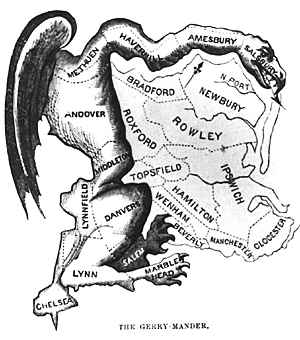
Cummins has taken to Brewed Fresh Daily to blog. An image is worth 1,000 words: he cleverly compares three new wards to the freaky lizard shape in Elbridge Gerry's 1812 redrawing of Massachusetts, which led to the coining of the term gerrymander (Gerry + salamander) -- a creepy animal, politics' spawn.

Monday, February 16, 2009

Council cash

Local pols have filed their 2008 campaign finance reports, and Henry Gomez has dug through Cleveland City Council's at his City Hall blog.

Highlights: Martin Sweeney has $313,000 in the fund he controls as council president and $141,000 in his own campaign fund (as of Jan. 1). No wonder the coup plot against him failed. His rival Matt Zone has $19,500.

Joe Cimperman collected $53,000 at a September fundraiser. Dona Brady has $103,000 (what's she going to do with it?). Zack Reed "spent more than $10,000 on other campaigns, cell phone bills and hotel rooms for conferences."

Meanwhile, Mayor Frank Jackson has a $633,000 war chest, just in case anyone decides to run against him.

Tuesday, January 27, 2009

More on the mayor's race

Picking up on my post about the mayoral race, Henry Gomez at cleveland.com drops a few more names of possible Frank Jackson challengers, including former city tech czar Michael DeAloia and councilmen Mike Polensek and Zack Reed (I will bet that Polensek and Reed won't run, but we'll see). Gomez also pointed out something I should have mentioned: Joe Cimperman is a political ally of Jackson's -- another reason Cimperman won't run.

In that previous post, I wrote that Chris Ronayne had thought about running for mayor this year. Actually, Ronayne was too coy to name the year he wanted to run. I just tweaked the post to reflect that.